
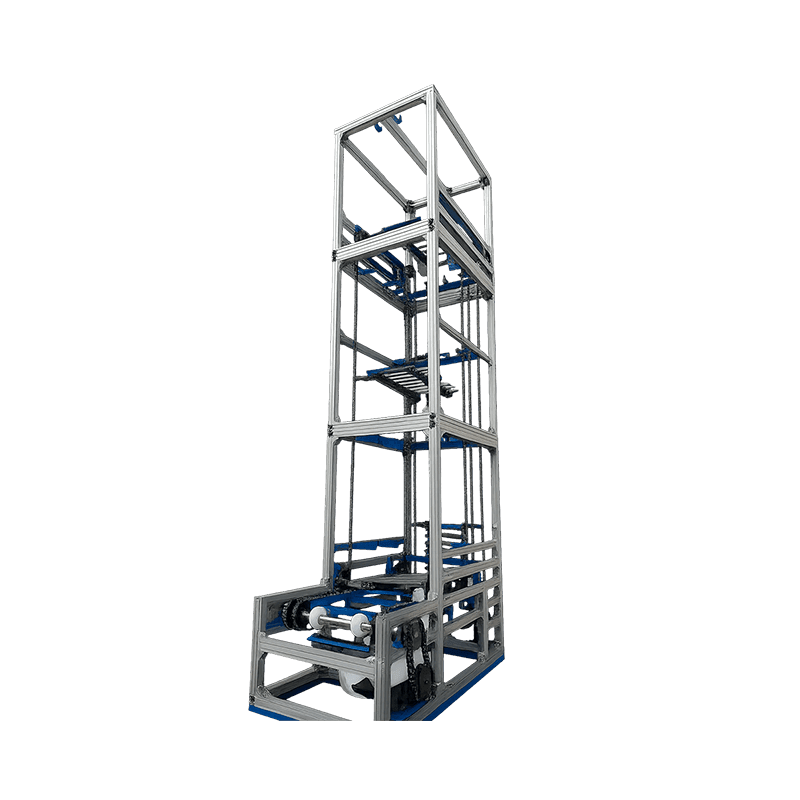










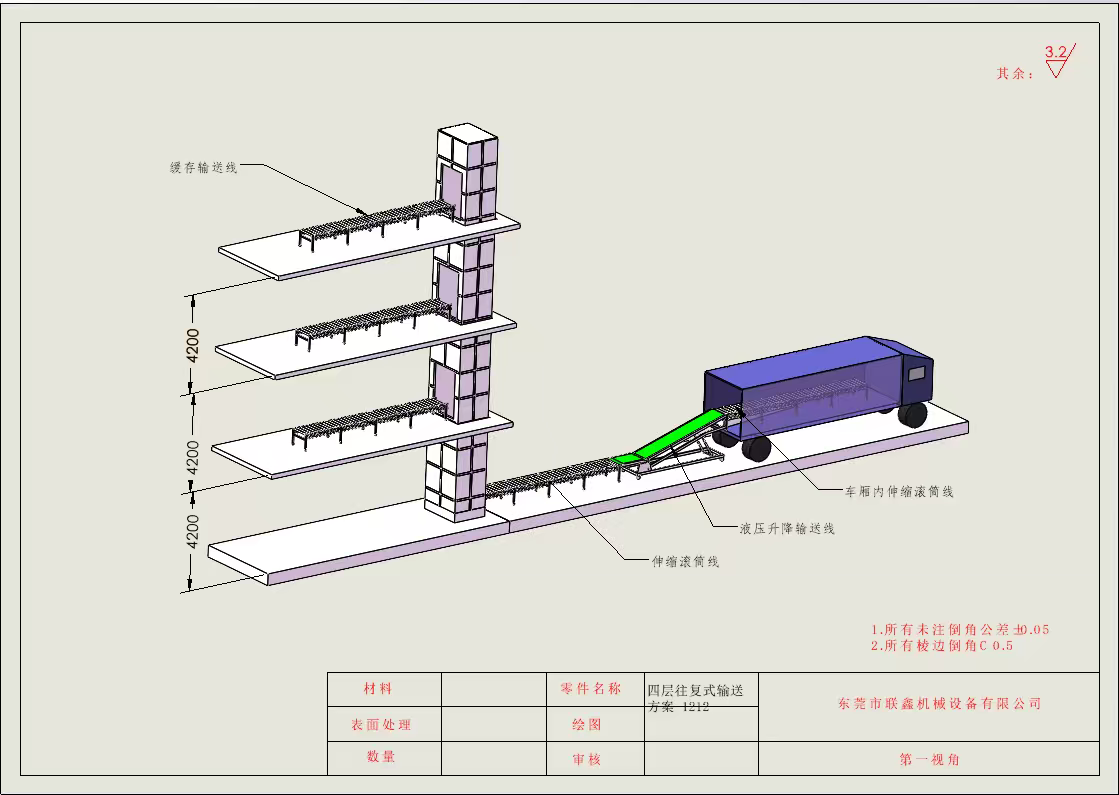
The 100 kg/m C-type Vertical Conveyor mainly solves the vertical transportation of goods between different floors. It is suitable for cartons, rolls, metal drums, plastic drums, and bagged goods with relatively stable shapes and a single-item weight of no more than 100 kg. It is usually arranged between floors in warehouses or factories, and can also be combined with Angetriebenes Rollenförderband und Hydraulischer Förderer for connection, transferring goods unloaded from trucks to upper-floor storage areas. Before procurement, first verify three boundaries: first, the lifting height must fall within the 4–20 meter model range; second, the goods dimensions must match the effective width; third, the positional relationship between the inlet end, outlet end, and the on-site roller line, platform opening, or floor edge must be determined in advance.
Applicable site and goods boundaries
This model is a C-type structure, with a load capacity configured at 100 kg/m, suitable for fixed lifting sections between floors. For the site, it is more direct to first look at the goods and inlet/outlet conditions than to start with motor power.
Applicable goods types include:
- Cartons
- Rolls
- Metal drums
- Plastic drums
- Bagged goods
Among them, the clearly specified single-item limit in the input data is no more than 100 kg per item. If the goods have a small bottom support area, are prone to rolling, have a high center of gravity, or the single-item weight is close to the upper limit, engineering confirmation is required for the conveying pitch, guidance, and infeed/outfeed control method.
The available width combinations are:
- 0.6 × 0.8 m
- 0.8 × 0.8 m
- 0.8 × 1.2 m
It is more appropriate here to judge by whether the overall dimensions of the goods fall within the corresponding width combination, while also checking the dimensions of each side. If the goods have a pallet, base support, drum support, protruding straps, or outer-box side flanges, the actual passing dimensions must be confirmed according to the final model or by engineering verification.
Situations that are not suitable for direct judgment based on the standard configuration include:
- Single item exceeds 100 kg
- Goods are soft, easy to deform, and the bottom cannot rest stably on the conveyor surface
- The infeed and outfeed opening is too narrow, so the goods need to turn to pass through
- Floor openings, platform openings, or guardrail positions restrict the equipment’s infeed and outfeed layout
So lesen Sie die wichtigsten Parameter ab
For this type of Vertical Conveyor, first check the key dimensions. Just review the few key parameters that affect layout and conveying limits.
| Parameters | Auswirkungen auf die Modellauswahl | So bestätigen Sie vor Ort |
|---|---|---|
| Lift height 4-20 m | It determines which model range to use, and also affects the installation location and civil works conditions | Measure the actual height from the floor to the loading/unloading surface of the target level |
| Load capacity 100 kg/m | Determines the conveying load limit per unit length | Count the weight of each item, the spacing between items on the machine, and the number of items on the machine at the same time |
| Single item ≤100 kg | Determines whether the goods can be conveyed within the standard range | Provide the typical item weight, maximum weight, and bottom dimensions |
| Effective width 0.6 × 0.8 m, 0.8 × 0.8 m, 0.8 × 1.2 m | Determines whether the goods can enter and pass through the lifting section smoothly | Provide the goods’ length, width, height, and whether they come with a pallet or base support |
| C-type structure | Affects the spatial relationship between the infeed end and the outfeed end | Mark the equipment entrance, exit, and pedestrian passage on the layout plan |
| Chain drive | Relates to the transmission structure and maintenance method | Confirm whether there is maintenance space around the equipment |
The model height coverage includes 4 m, 5 m, 6 m, 7 m, 8 m, 9 m, 10 m, 11 m, 12 m, 13 m, 14 m, 15 m, 16 m, 17 m, 18 m, 19 m, and 20 m. Motor power changes with height, approximately 750 W, 1500 W, 2200 W, 3700 W, and 5500 W. For procurement decisions, the key is not to compare power in isolation, but to first define the lift height and goods conditions clearly, then determine the corresponding model.
How the front and rear equipment connect
The 100 kg/m C-type Vertical Conveyor is usually not used alone. On site, it is more commonly used as a vertical lifting section between upper and lower floors, with a horizontal conveyor or loading/unloading equipment connected before and after it.
Typical connection methods include:
- Truck unloading end connected to Hydraulischer Förderer, then connected to Angetriebenes Rollenförderband, and finally enters this machine to lift to the floor
- A roller conveyor is connected at the first-floor buffer area; after lifting to the second floor or a higher level, the roller line inside the floor then handles distribution
- Direct loading and unloading at the floor opening, but the platform edge protection, guidance, and manual loading/unloading position must also be checked
When connecting, focus on confirming the following points:
- Whether the incoming material pace from the front section will cause goods to accumulate at the inlet
- Whether the cargo needs to be reoriented before entering the Vertical Conveyor
- Whether there is a height difference, gap, or corner between the discharge end and the floor conveyor line
- Whether bucket-type and roll-type cargo needs lateral positioning to prevent deviation
- Whether personnel need to assist in straightening the cargo at the feed end or discharge end
If the site layout is "truck to floor warehouse, " you can refer to the relevant case: Case study of a warehouse Vertical Conveyor transporting metal sheets to the second floor. If the front section is for truck loading and unloading connection, you can also view LKW-Beladung: Angetriebene Rollenbahn mit hydraulischem Förderer.
How to distinguish between models in the same series and similar structures
If it has already been determined on site that goods need to be conveyed between floors, first distinguish the load class, then the structural type.
- When the cargo weight, conveying density, or load per unit length needs to be configured at 100 kg/m, this model belongs to a higher load class; if the cargo on site is lighter, you can compare it with Vertikalförderer vom Typ C, 50 kg/m
- When the site is more concerned with the direction of the infeed and outfeed ports and the layout relationship of the equipment within the plane, you can compare the 100 kg/m Vertikalförderer vom Typ Z
- If the cargo is lighter and you also need to compare different structural types, you can also look at 50 kg/m Vertikalförderer vom Typ Z
The differentiation approach can be simplified as the table below:
| On-site conditions | Urteil | Empfohlene Maßnahme |
|---|---|---|
| A single item is close to 100 kg, or there are many items on the conveyor section at the same time | First verify according to the 100 kg/m class | Prioritize confirming this model or the same-class Z-type structure |
| The cargo is lighter | The load boundary may not require 100 kg/m | Compare with the 50 kg/m C-type Vertical Conveyor |
| The direction of the infeed and outfeed ports is constrained by the position of the floor opening | First distinguish between C-type and Z-type | Have engineering confirm the structure according to the inlet and outlet directions |
| The lifting height is within 4-20 meters, but the installation space is narrow | Both the structure and maintenance space need to be checked | Provide the floor plan and section view to confirm the layout |
If the cargo exceeds 100 kg per piece, or if you want to increase the load per unit length, it cannot be judged directly from this page; engineering confirmation of the load capacity and conveying method is required.
Anlagenaufbau und Wartung vor Ort
This model is fixed-installation equipment. During layout, the equipment body space, floor opening position, infeed and outfeed platforms, and personnel access routes should all be considered together.
Key points to confirm during on-site layout:
- Whether the equipment foundation is level and whether it can meet the requirements for fixed installation
- Whether the floor entry and exit points are aligned with the height of the conveying surface; if not, a connection treatment is required first
- Whether there are any interferences from columns, walls, door openings, guardrails, or fire protection facilities near the entry and exit openings
- Is space reserved on both sides of the equipment for routine inspection and maintenance?
- For barrel-type and roll-type goods, is positioning or manual alignment needed at the inlet?
For maintenance, the available information clearly shows that this machine uses chain drive. For users, daily maintenance mainly focuses on the transmission components, the pass-through condition at the infeed and outfeed ends, and inspection of fixed parts. If the lifting height is relatively high, the equipment needs to reserve stable access for inspection and a shutdown maintenance position. The packaging length data corresponds to the equipment height, with a range of about 4000-20000mm; this is more suitable for receiving, handling, and site entry confirmation, and should not be used as the main parameter for on-site conveyor assessment.
Bestätigung vor dem Kauf
To help determine as quickly as possible whether this model is suitable for the site, please provide the following information in one go when requesting a quotation or discussing a solution:
- How many floors does it need to lift to, and what is the actual height from the ground to the target conveying surface?
- What type of goods are they—cartons, rolls, metal drums, plastic drums, or bagged goods—and what is the maximum weight per piece?
- What are the overall dimensions of the goods, and do they have pallets, bottom supports, or protruding structures?
- What equipment is connected before the infeed end, and what equipment is connected after the outfeed end?
- Where in the indoor area is the equipment planned to be installed, and is there a floor plan or a floor cross-section drawing?
- What are the dimensions of the floor opening, platform opening, guardrail, and passage width?
- Have the on-site power supply conditions and maintenance space for the equipment already been reserved?
Häufig gestellte Fragen:
1. Is it suitable to directly deliver goods unloaded from a truck to an upper floor?
It is suitable for the floor-lifting section in between, but the front section usually still requires a Hydraulic Conveyor or roller conveyor to transfer the goods from the truck opening to the Vertical Conveyor inlet. The connection method must be confirmed according to the on-site layout.
2. What cargo conditions need to be confirmed?
First confirm that the weight of a single item does not exceed 100 kg, then confirm the length, width, and height of the cargo, the bottom support surface, and whether it is prone to rolling or shifting. For barrel-type and roll-type goods, also confirm the guiding and positioning method.
3. How should the lifting height be selected?
This model group covers 4-20 meters. First measure the actual lifting height, then choose the corresponding model from 4 meters to 20 meters. The height difference between the inlet and outlet and the installation base also need to be confirmed together.
4. What drawings or dimensions should be provided before purchase?
It is recommended to provide a plan view of the installation area, a floor cross-section drawing, the positions of the infeed and outfeed openings, the cargo dimensions, and the equipment types for the front and rear sections. If there is already a roller line or platform opening dimension on site, please send that as well so that the connection relationship can be confirmed.
5. How should the case be judged when the cargo dimensions do not exactly match the effective width?
The available effective width combinations on this page are 0.6×0.8 m, 0.8×0.8 m, and 0.8×1.2 m. If the goods have pallets, outer box flanges, drum hoops, or straps, the actual passing dimensions should be confirmed according to the final model or project requirements.