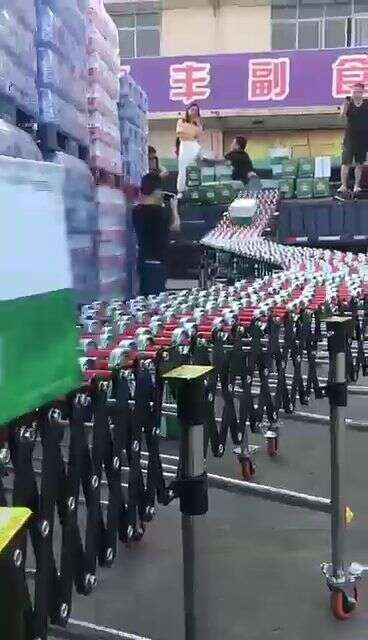
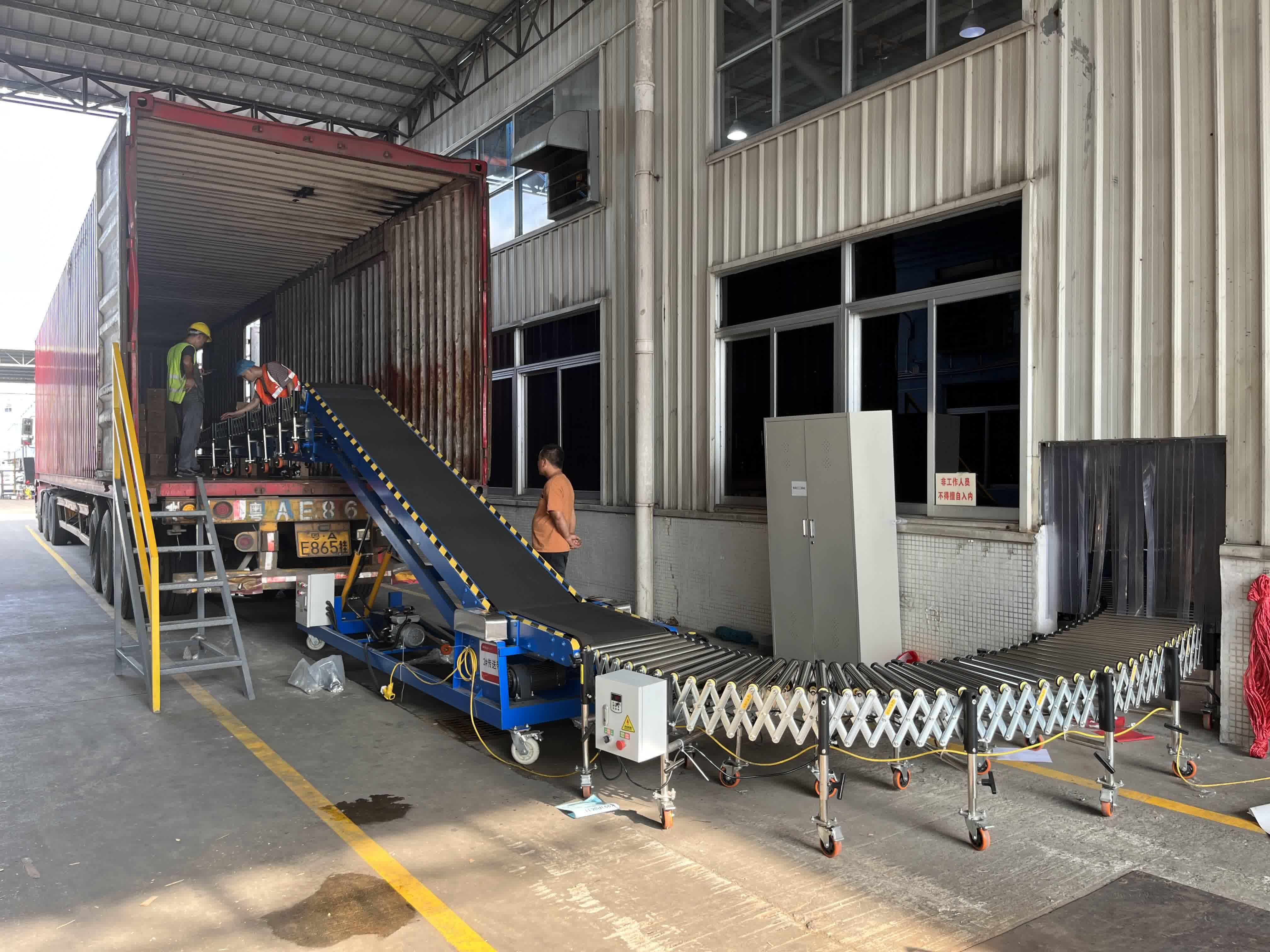
This case uses a medium hydraulic conveyor together with a Multi-Wedge Belt Powered Roller Conveyor to continuously transport boxed cargo from inside the truck to ground-level pallets. One person pushes the goods inside the truck while two people stack them on the ground, achieving a unloading mode where people only push and place the goods, without repeatedly carrying boxes on and off the truck.
Project background and unloading challenges
Typical operating conditions
- Cargo type: boxed goods such as standard cartons and plastic crates.
- Loading method: goods are loosely placed in the truck, then manually carried to the rear inside the compartment.
- Unloading location: ground-level pallet or the buffer area in front of the rack.
- Staffing: the original plan usually required 3–4 people to shuttle frequently between the truck opening and the ground pallets, resulting in high labor intensity.
The main difficulties are:
- The height difference between the truck floor and the ground requires frequent lifting of cartons up and down;
- Workers have to bend, turn, and carry boxes off the truck repeatedly, which quickly leads to fatigue;
- Cargo flow is not smooth: it piles up sometimes at the truck opening and sometimes on the ground, making the site look disorganized.
Solution: medium hydraulic conveyor + Powered Roller Conveyor
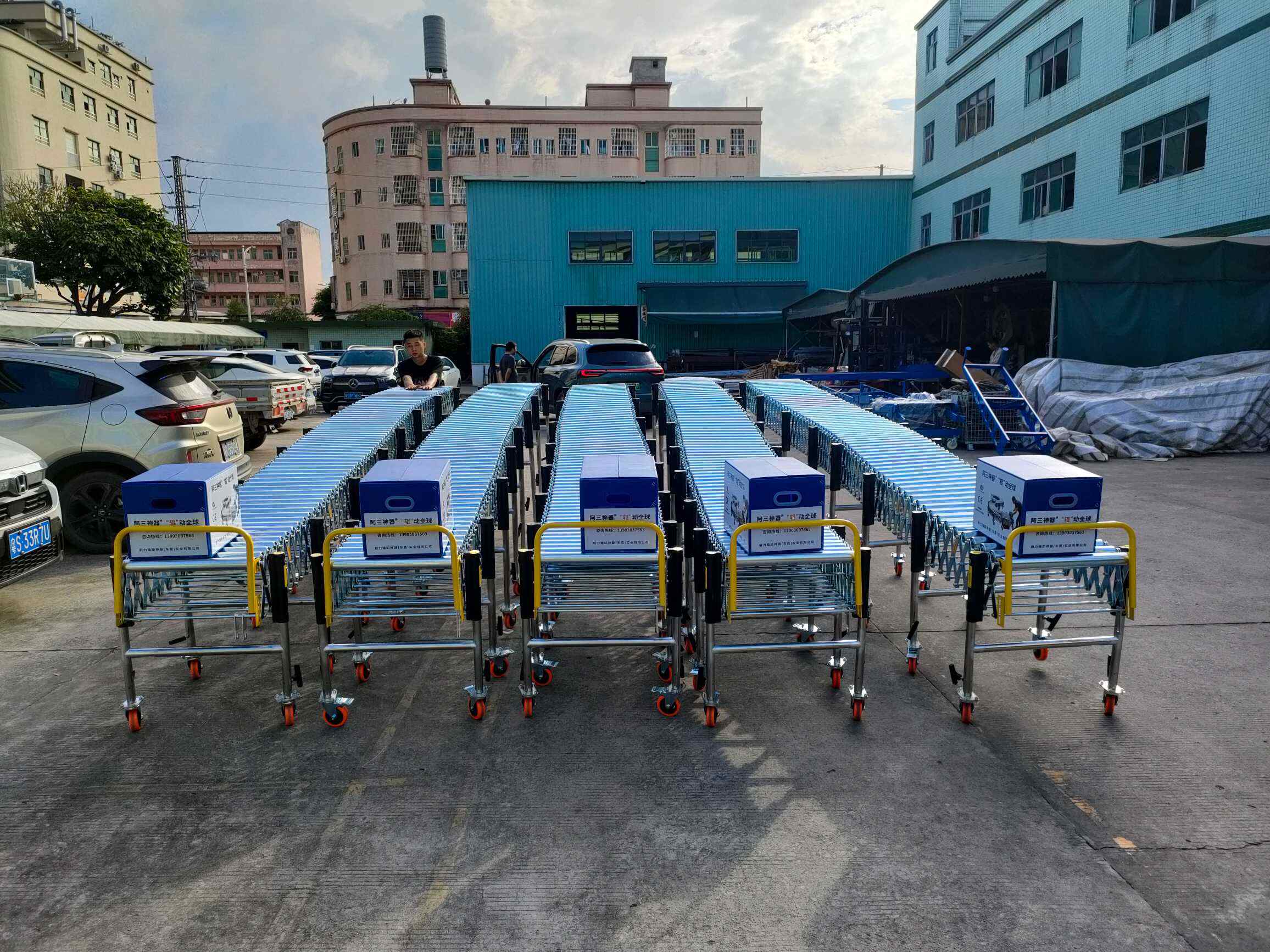
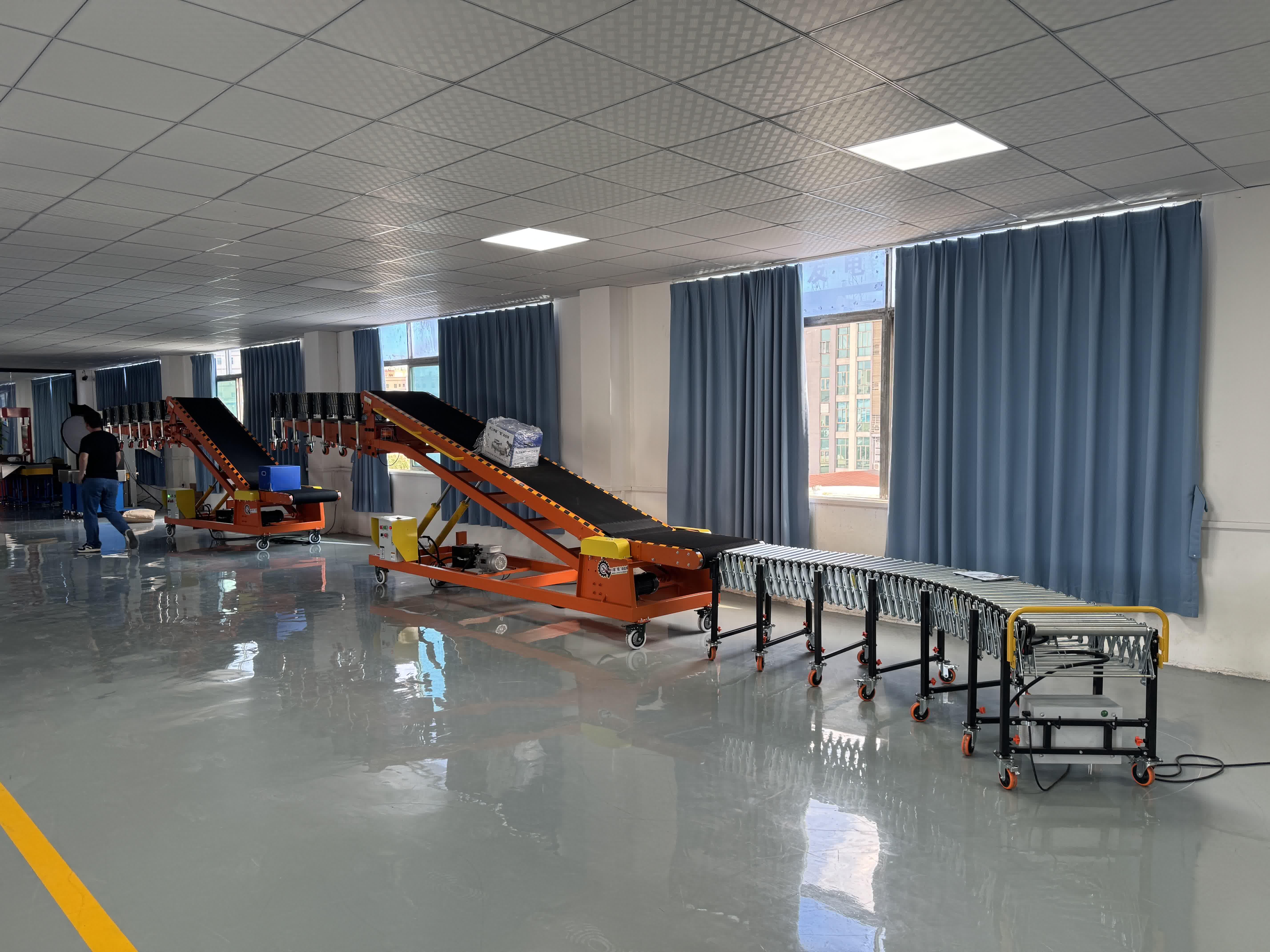
On site, a medium hydraulic conveyor is used to bridge the truck height, followed by a section of ground-level Multi-Wedge Belt Powered Roller Conveyor. The whole line extends from deep inside the truck all the way to the ground pallet, combining height transition with horizontal conveying.
Layout method
- Medium hydraulic conveyor: one end extends into the truck, while the other end lands at the feed end of the ground roller line, mainly solving the height difference between the truck and the ground.
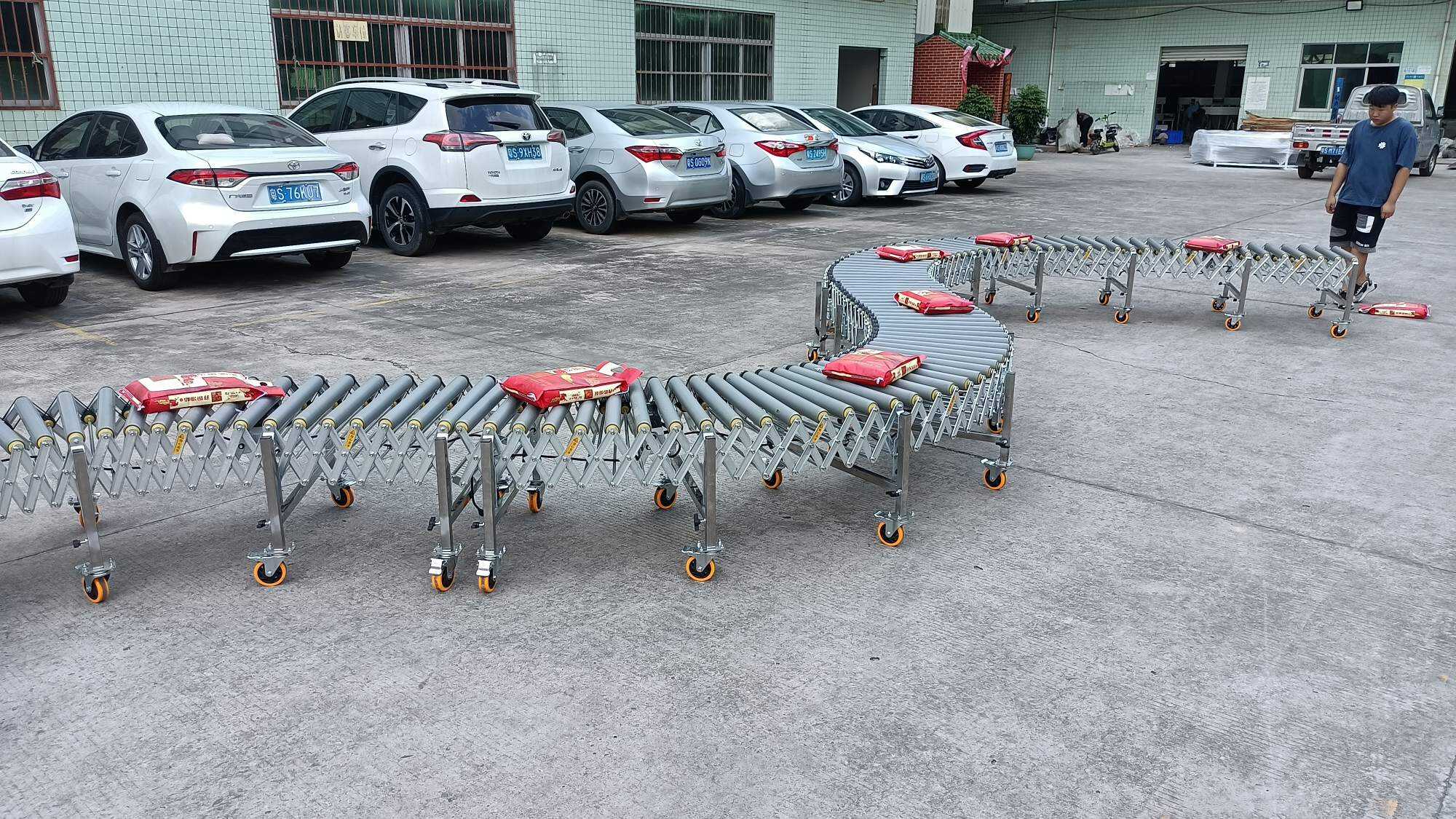
- Multi-Wedge Belt Powered Roller Conveyor: extends along the ground to the pallet area, conveying boxed goods to the side of the palletizing station.
- This forms a continuous conveying channel from deep inside the truck to the area in front of the ground pallet.
The key equipment used in this solution is a medium hydraulic conveyor:
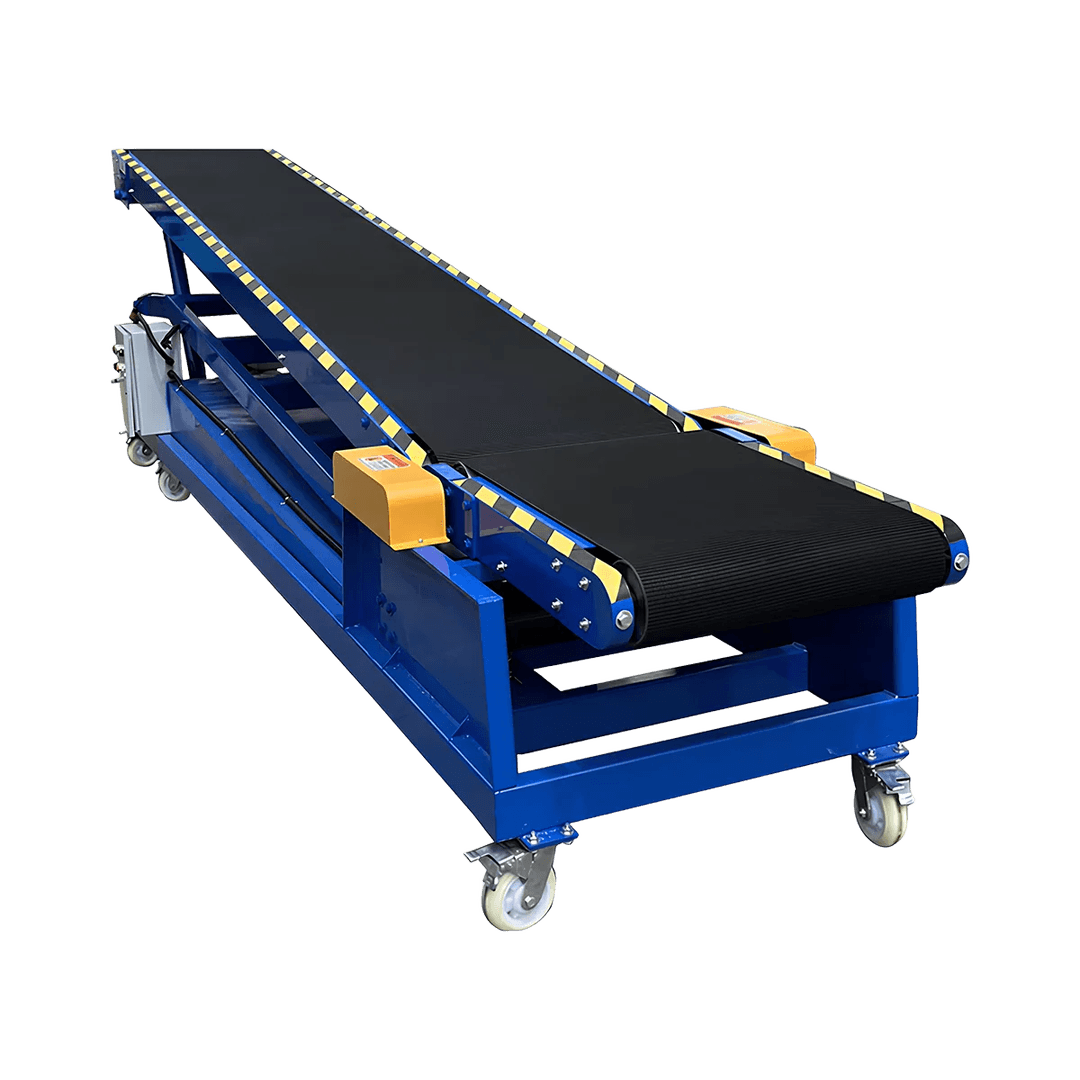
Mittlerer Hydraulikförderer
Medium Hydraulic Conveyor is specially designed for sites without loading and unloading platforms and is suitable for trucks under 40 ft. The hydrauli...
 Metallfass
 Kunststofffass
 Rolle
Rolle
 Karton
 Verpackt
The ground section uses a Multi-Wedge Belt Powered Roller Conveyor line for continuous conveying of boxed goods:
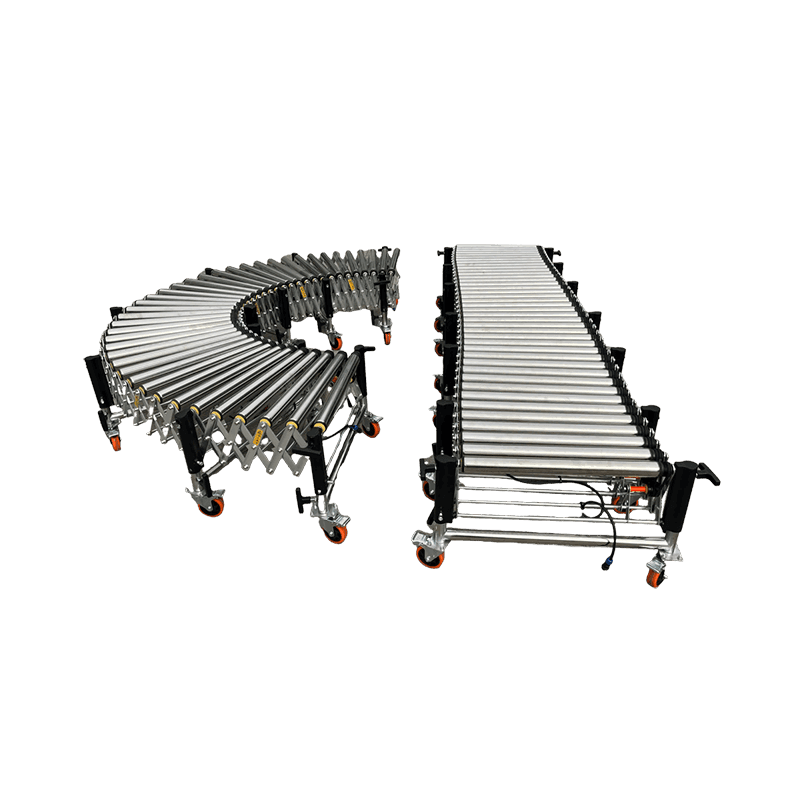
Rollenförderer mit Keilriemenantrieb
The multi-wedge belt Powered Roller Conveyor uses a multi-wedge belt drive design to achieve smooth and efficient cargo conveying. Motor spacing range...
Kunststofffass
Metallfass
Karton
Rolle
For more configuration ideas on how Multi-Wedge Belt rollers and a medium-duty climber can be used in large-angle loading and unloading, please refer to "Analysis of Large-Angle Loading and Unloading Applications for Multi-Wedge Belt Powered Roller Conveyor and Medium-Duty Climber".
Staff allocation
- Inside the truck: 1 person pushes boxed goods from the rear of the trailer to the climber inlet, allowing the goods to enter the conveyor line naturally, with no need to carry the boxes out of the truck.
- On the ground: 2 people stand on both sides of the pallet, take boxes from the end of the roller line, and complete palletizing or transfer them to the next workstation.
The whole system still requires manual involvement, but the walking and carrying distance is greatly reduced. The work is more about "taking boxes at hand and placing them nearby" rather than carrying boxes over long distances.
Actual unloading process diagram
Truck-side operation
- Extend one end of the medium-duty climber into the vehicle trailer so that it connects smoothly and basically level with the trailer floor.
- The operator inside the trailer slides or moves the boxed goods a short distance onto the belt above the climber in the planned order.
- After starting the climber and the roller conveyor, the boxes are automatically conveyed toward the rear of the truck along the belt, without needing to be carried manually to the door.
Ground-side operation and palletizing
- After passing through the climber, the boxes drop onto the ground Multi-Wedge Belt Powered Roller Conveyor and continue moving forward.
- The two ground operators stand on both sides of the conveyor line and, according to pallet layout, product type, or batch requirements, easily take boxes from the end of the roller line and palletize them.
- After palletizing, a forklift or pallet jack can be used to transfer the full pallet to the warehouse location, achieving a smooth transition from "box to pallet".
In this workflow:
- There is no longer a large pile of boxes waiting to be unloaded inside the trailer, and the goods flow steadily from the rear of the trailer to the ground;
- The ground staff have a fixed work area, and their actions are mainly "take and place, " making the pace easy to control;
- The unloading process is closer to continuous conveying, reducing interruptions and waiting time.
Application results: changes in efficiency and labor intensity
Improved efficiency
With the same three-person setup, unloading efficiency is improved mainly in the following ways:
- Each box is manually "handled" only once, while the rest of the journey is completed by the conveyor;
- The people inside the trailer no longer need to get on and off frequently, saving time for climbing in and out and for round trips;
- The two people on the ground focus on palletizing, reducing waiting and unnecessary walking.
For more on the efficiency performance of medium-duty climbers in express delivery, e-commerce warehousing, and similar scenarios, please refer to "How Medium-Duty Climbers Help Improve Loading and Unloading Efficiency in Express Warehousing".
Reduced labor intensity
- Getting on and off the vehicle is greatly reduced, lowering pressure on the knees and ankles;
- Carrying boxes out of the truck and long-distance transport are replaced by the conveyor line, and the main labor becomes short-distance picking and placing;
- The operating height is closer to the human comfort range. The conveyor height can be fine-tuned according to pallet height, reducing how often workers need to bend over.
Overall, three people can complete unloading tasks that originally required more people, while the work pace is more stable, fatigue is reduced, and it is better suited for long hours of continuous operation.
Applicable industries and expandable configurations
Applicable scenarios
The combination of "medium-duty climber + ground powered roller line + palletizing" in this case is well suited for:
- Unloading boxed goods at express delivery, e-commerce transfer warehouses, and community distribution warehouses;
- Unloading standard boxed products such as food, beverages, and daily chemicals at receiving docks.
- Receiving stations for standard boxed goods in the finished goods and raw materials warehouses of manufacturing enterprises.
When loading and unloading space is limited, the Multi-Wedge Belt Powered Roller Conveyor can also be flexibly arranged according to on-site turning and diverging requirements; see the related practice: "An Analysis of the Applications of the Multi-Wedge Belt Powered Roller Conveyor in Narrow Spaces".
For a systematic understanding of how the Hydraulic Conveyor series adapts to different vehicle types, please see:
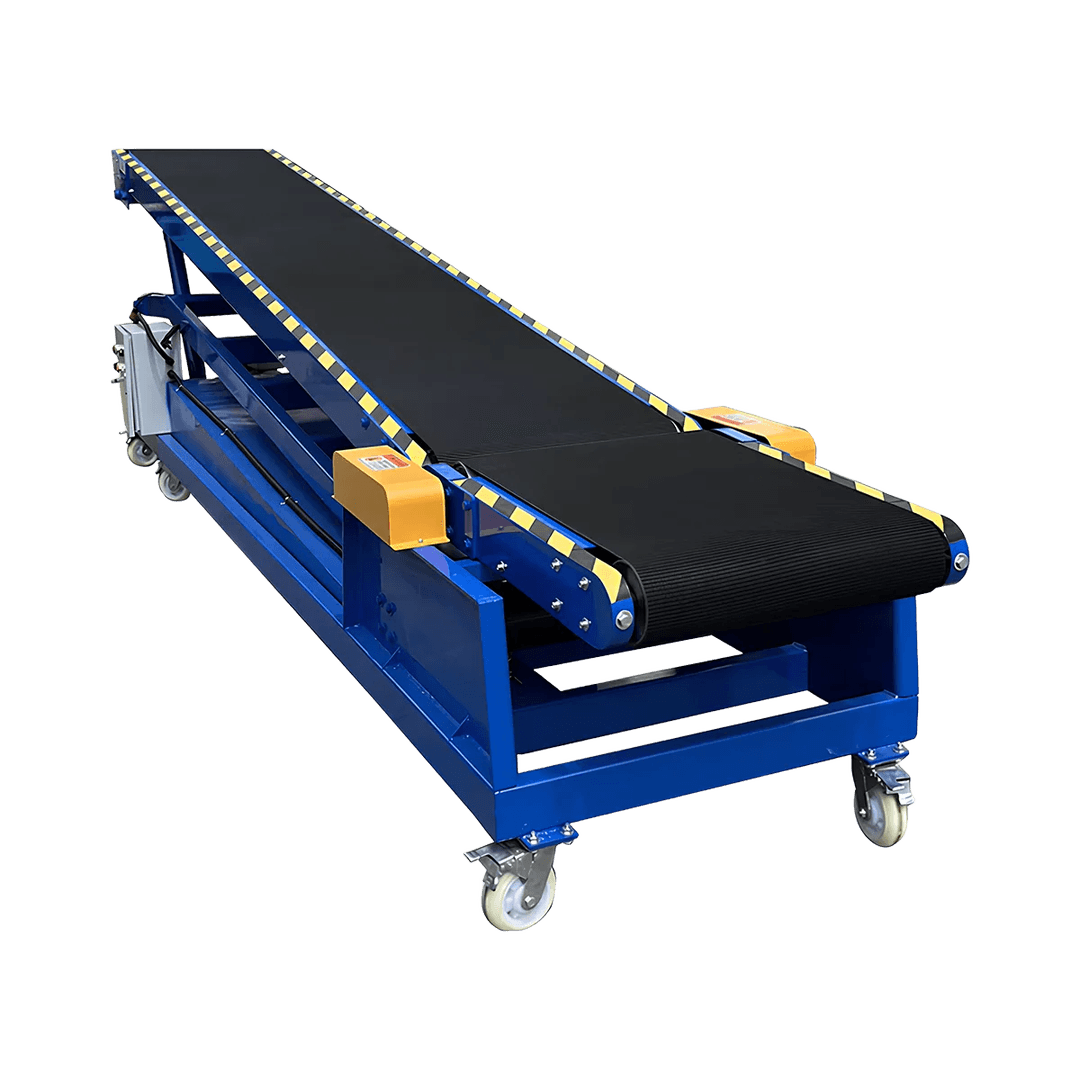
Hydraulische Förderband-Baureihe
The hydraulic lifting conveyor is designed specifically for warehouses, factories, and logistics sites without loading docks. It enables smooth and sa...
Metallfass
Kunststofffass
Rolle
Karton
Verpackt
If you later want to add photoelectric sensors to the roller line to achieve box spacing control or integration with the warehouse system, you can also refer to "Application Scenarios and Advantages of Adding Photoelectric Sensors to a Powered Roller Conveyor for Spaced Cargo Conveying".
Integration ideas with other conveying equipment
Based on this case, you can also further:
- Extend the floor roller line to connect with the internal warehouse conveying system, achieving an integrated "truck bed—pallet—storage line" flow;
- According to floor requirements, combine it with a vertical Elevator to send pallets or boxes to the upper storage area, creating a three-dimensional logistics route.
If you need to plan a complete loading, unloading, and storage conveying system on a larger scale, you can combine product series such as powered rollers and Hydraulic Conveyor for overall selection:
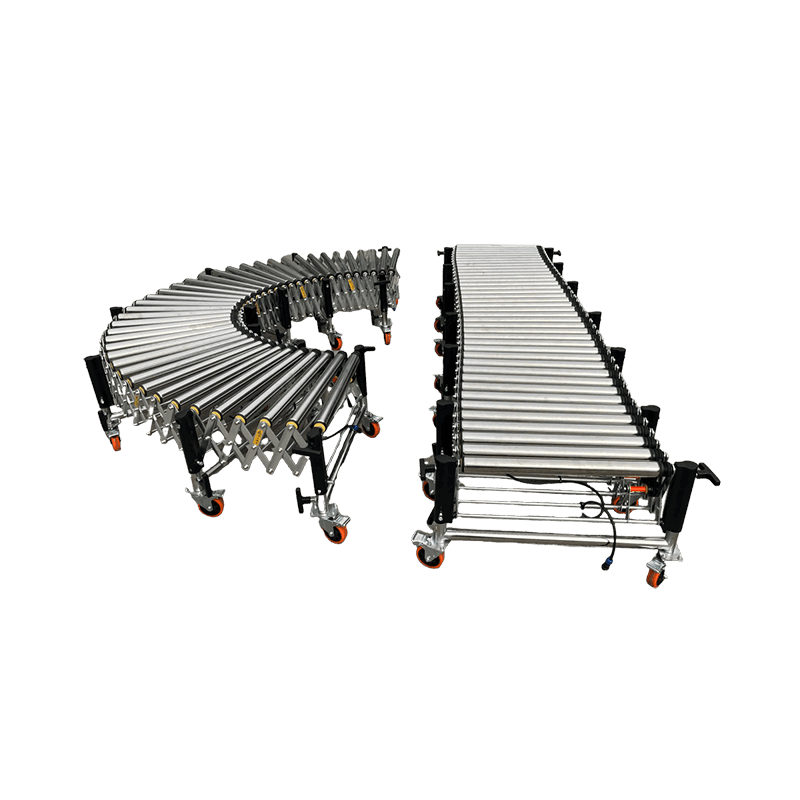
Serie der angetriebenen Rollenförderer
The powered roller conveyor is designed specifically to meet conveying needs for the final stretch of loading and unloading, enabling continuous and s...
Kunststofffass
Metallfass
Karton
Rolle