
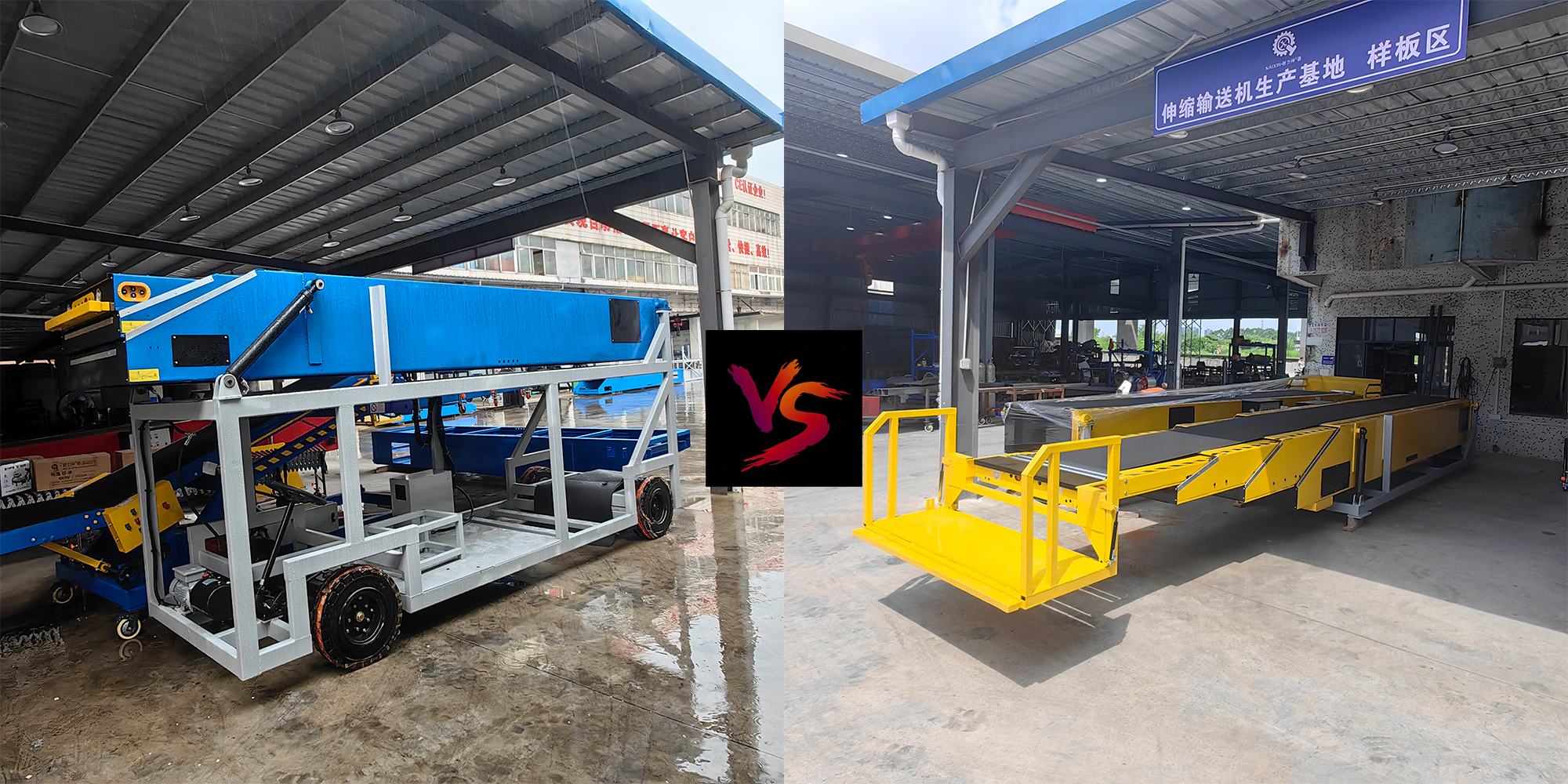
When choosing a telescopic belt conveyor for truck or container loading and unloading, one of the first decisions is whether to install a fixed conveyor or use a mobile model.
Both configurations are designed to extend the conveying point into a truck, trailer, or container. However, they serve different operational needs. A fixed telescopic conveyor is suitable for a dedicated loading position, while a mobile telescopic conveyor offers greater flexibility when equipment needs to serve different locations.
The right choice depends on your loading workflow, facility layout, available floor space, vehicle positions, and equipment requirements.
In this guide, we explain the differences between fixed and mobile telescopic belt conveyors, their typical applications, and the factors to consider before selecting a configuration.
1. What Is a Fixed Telescopic Belt Conveyor?
A fixed telescopic belt conveyor is installed at a designated loading or unloading position. Once installed, the machine generally remains in the same location during normal operation.
The conveyor can extend and retract to move its working end into a truck, trailer, or container. This allows goods to be conveyed closer to the required loading or unloading position without moving the entire machine.
Fixed telescopic conveyors are suitable for facilities with stable loading arrangements, such as warehouses with dedicated truck bays, distribution centers, and manufacturing plants with regular dispatch operations.
Key Characteristics of a Fixed Telescopic Conveyor
-Installed at a dedicated loading or unloading position.
-Can be anchored to a suitable floor or loading structure.
-Extends and retracts during normal conveying operations.
-Suitable for facilities with a consistent loading workflow.
-Can be integrated with compatible roller conveyors, belt conveyors, and other material handling equipment.
When Is a Fixed Conveyor a Good Choice?
A fixed conveyor may be appropriate when trucks regularly arrive at the same loading bay, the loading area layout rarely changes, and the equipment does not need to move between different positions.
For facilities with a stable workflow, a fixed installation can provide a consistent conveying arrangement and simplify integration with surrounding equipment.
2. What Is a Mobile Telescopic Belt Conveyor?
A mobile telescopic belt conveyor combines telescopic conveying capability with a mobility system that allows the machine to be repositioned when required.
Unlike a fixed conveyor, a mobile model is designed for facilities where loading or unloading locations may change. Depending on the machine configuration, it can be moved between suitable operating positions rather than remaining permanently installed at one loading bay.
Mobile telescopic conveyors are useful in warehouses, logistics facilities, and manufacturing environments where equipment flexibility is important.
Key Characteristics of a Mobile Telescopic Conveyor
-Designed to be repositioned between suitable operating locations.
-Includes a base and a mobility system.
-Can support different loading arrangements, depending on the configuration.
-May be suitable for facilities without a conventional loading dock.
-Mobility options depend on machine weight, length, floor conditions, and site layout.
When Is a Mobile Conveyor a Good Choice?
A mobile conveyor may be suitable when multiple loading positions need to be served, the facility layout changes, or the same equipment needs to be used at different locations.
It can also be considered where trucks cannot consistently align with a permanent loading dock.
However, mobility does not mean every machine can be moved manually or used on any floor. The movement method, operating position, floor conditions, and required clearance should be confirmed for the selected model.
3. Fixed vs. Mobile Telescopic Belt Conveyor: Key Differences
The main difference is whether the complete machine is intended to remain at a dedicated position or be moved between operating locations.
| Comparison Factor | Convoyeur télescopique fixe | Convoyeur télescopique mobile |
| Installation | Installed at a designated position | Designed to be repositioned |
| Machine base | Fixed models do not use the mobile base configuration | Includes a base and mobility system |
| Loading positions | Best suited to dedicated loading areas | Suitable for facilities needing flexible positioning |
| Layout flexibility | Depends on the permanent installation | Offers greater flexibility in equipment placement |
| Movement | Not normally moved during daily operation | Movement method depends on the selected mobility system |
| Site requirements | Requires a suitable permanent installation position | Requires suitable floor conditions and movement clearance |
| System integration | Can be integrated into a stable conveyor line | Can be integrated where the operating layout supports repositioning |
| Selection priority | Stable workflow and permanent location | Flexibility and changing loading requirements |
Neither configuration is universally better. The appropriate choice depends on how the equipment will be used and the physical conditions of the facility.
4. Advantages of a Fixed Telescopic Belt Conveyor
A fixed telescopic conveyor is worth considering when loading and unloading operations take place at a consistent location.
Its main advantages include:
Consistent positioning: The conveyor remains aligned with the designated loading area, supporting a repeatable operating workflow.
Suitable for dedicated loading bays: It works well in facilities where trucks regularly use the same loading position.
Integration with existing equipment: A fixed conveyor can form part of a larger conveying route when connected equipment and the installation layout are compatible.
Permanent installation: Anchoring the machine at a designated position can be appropriate when the facility does not require frequent equipment relocation.
Potential Limitations:
A fixed conveyor is less suitable when the equipment must regularly serve multiple loading positions. Changing its location may require installation work and adjustments to the surrounding conveying arrangement.
Before selecting a fixed model, confirm that the intended position, vehicle access, and loading workflow are unlikely to change significantly.
Advantages of a Mobile Telescopic Belt Conveyor
A mobile telescopic conveyor is worth considering when flexibility is an important part of the loading process.
Flexible positioning: The machine can be repositioned to serve different suitable loading locations, depending on its mobility configuration.
Adaptability to changing workflows: It may be useful when truck positions, loading areas, or operating arrangements change.
Useful where a conventional loading dock is unavailable: A suitable mobile configuration can support certain loading and unloading arrangements without requiring a permanently installed conveyor at every position.
Potentially broader equipment utilization: A facility may be able to use the same conveyor at different positions instead of installing separate fixed machines at each location. Whether this is practical depends on operating schedules, movement time, and site layout.
Potential Limitations
Mobile equipment requires sufficient clearance for movement and a suitable floor surface. The machine must also be positioned and secured according to its operating requirements before conveying begins.
Different mobility systems have different limitations. The machine’s length, weight, drive configuration, and floor conditions should all be considered before choosing a mobile model.
6. Which Type Is Better for Truck and Container Loading?
Both fixed and mobile telescopic belt conveyors can be used for truck and container loading and unloading. The choice depends on the way vehicles arrive and how the loading area operates.
Fixed Conveyor for Dedicated Loading Bays
A fixed telescopic conveyor may be suitable when:
- Trucks consistently use the same loading bay.
- The conveyor can remain in a permanent position.
- The loading workflow is stable.
- The conveyor needs to connect with a fixed warehouse or production-line conveying system.
Mobile Conveyor for Flexible Loading Areas
A mobile telescopic conveyor may be suitable when:
- Different loading positions need to be served.
- Trucks cannot always use the same loading position.
- The facility needs to reposition equipment as workflows change.
- A conventional loading dock is unavailable and the site conditions support a mobile solution.
For either type, the conveyor’s extension, working height, belt width, load rating, and compatibility with the loading area must be checked separately.
Choosing fixed or mobile equipment does not replace the need to select the correct conveying specifications.
Does the Number of Sections Affect the Fixed or Mobile Choice?
Yes, the number of sections is an important design consideration, but it does not determine whether a conveyor must be fixed or mobile.
Naili telescopic belt conveyors are available in 2-section, 3-section, 4-section, and 5-section configurations.
- 2-section: One fixed section and one telescopic section.
- 3-section: One fixed section and two telescopic sections.
- 4-section: One fixed section and three telescopic sections.
- 5-section: One fixed section and four telescopic sections.
The number of sections influences the available telescopic reach and overall machine structure. Machine length and weight also affect which mobility system is appropriate.
For example, a mobility configuration that is practical for a shorter conveyor may not be suitable for a longer or heavier machine.
Therefore, select the section configuration according to the required reach first, then confirm the appropriate fixed or mobile arrangement and mobility system.
Related reading: Combien de sections faut-il pour un convoyeur télescopique ? Guide complet de sélection
8. What Should You Consider Before Choosing a Mobile Conveyor?
A mobile conveyor must be suitable for both the conveying task and the conditions in which the machine will be moved.
Consider the following factors:
Machine length and weight: Longer or heavier machines may require a different mobility system from shorter models.
Floor conditions: The floor should be suitable for the machine’s weight and movement system. Surface flatness, strength, and any obstacles along the movement route should be evaluated.
Movement method: Depending on the design, mobility options may include casters, a powered drive system, or other suitable movement arrangements. Not every option is available for every machine.
Movement clearance: The facility must provide sufficient space to reposition the machine safely.
Operating position: The machine must be correctly positioned before conveying begins, following the manufacturer’s operating instructions.
Loading height and access: The selected configuration must fit the intended truck or container loading arrangement.
Safety requirements: Movement, positioning, braking, and operation should follow the machine’s specified safety procedures.
These checks help ensure that the selected mobile conveyor is suitable for the facility rather than simply being movable in principle.
9. Can Fixed and Mobile Telescopic Conveyors Be Integrated with Other Equipment?
Yes. Both fixed and mobile telescopic conveyors can form part of a larger material handling system when the equipment layout and interfaces are designed appropriately.
A conveying system may include:
- Roller conveyors
- Powered roller conveyors
- Belt conveyors
- Incline conveyors
- Lifting equipment
- Existing warehouse or production-line conveying equipment
For example, goods can move from a production line or warehouse conveying route onto a telescopic conveyor for truck or container loading.
A fixed conveyor may be easier to integrate into a permanent conveying route because its position remains stable. A mobile conveyor can provide flexibility, but the connections to other equipment must account for repositioning and the intended operating arrangement.
Optional counting functions and warehouse-system integration may also be considered when required by the project.
Naili can provide individual conveyor equipment or help configure a combination of conveyors according to the customer’s material handling requirements.
10. Fixed vs. Mobile Telescopic Conveyor: Selection Checklist
Use this checklist to compare the two configurations for your facility.
| Question | Consider a Fixed Conveyor When… | Consider a Mobile Conveyor When… |
| Where will loading take place? | The loading position is permanent | Loading positions may change |
| How often will the machine move? | Relocation is rarely required | Repositioning is part of the workflow |
| What is the facility layout? | The layout is stable | Flexible positioning is important |
| Is there a loading dock? | A permanent loading bay is available | A suitable mobile arrangement may help where a dock is unavailable |
| Will it connect to another conveyor? | A stable, permanent connection is required | The layout supports the intended mobile operation |
| What are the floor conditions? | The installation supports permanent mounting | The floor and movement route suit the mobility system |
| What machine configuration is required? | The design suits the fixed installation | The design and mobility system suit the machine’s length and weight |
This checklist is a starting point. The final selection should also account for required telescopic reach, working height, belt width, load rating, and the characteristics of the goods being conveyed.
11. Frequently Asked Questions
A fixed telescopic conveyor is installed at a dedicated loading position, while a mobile telescopic conveyor is designed to be repositioned between suitable operating locations. Both can extend and retract during conveying operations.
No. A mobile conveyor provides positioning flexibility, but it also requires suitable floor conditions, movement clearance, and an appropriate mobility system. A fixed conveyor may be more suitable for a facility with a stable, dedicated loading position.
A fixed conveyor can potentially be relocated, but it may require removal of its anchoring, repositioning, and reinstallation. A mobile conveyor is designed specifically to support repositioning according to its operating requirements.
It may be suitable for certain applications without a conventional loading dock. The machine’s working height, mobility system, vehicle position, and site conditions must be checked before confirming suitability.
The required movement method depends on the machine’s design, length, weight, and operating environment. Different mobility systems are available for different applications, and the suitable configuration should be confirmed with the manufacturer.
Yes. Both configurations can support container loading and unloading when the selected conveyor provides the required reach, working height, belt width, and load capacity.
Yes. A telescopic conveyor can be integrated with compatible roller conveyors, belt conveyors, and other material handling equipment. The connection arrangement depends on the system layout and whether the telescopic conveyor is fixed or mobile.
12. How to Choose the Right Telescopic Conveyor for Your Facility
The decision between a fixed and mobile telescopic belt conveyor should begin with the way your facility operates.
If trucks regularly use a dedicated loading bay and the conveyor can remain in one position, a fixed model may be appropriate. If loading positions change or the same equipment needs to serve different locations, a mobile configuration may be worth considering.
After determining the installation type, confirm the required telescopic reach, number of sections, total length, belt width, load rating, working height, and any required system integration.
Naili offers fixed and mobile telescopic belt conveyors for different truck and container loading applications. The equipment configuration can be selected according to the facility layout, loading workflow, and material handling requirements.
Find the Right Telescopic Conveyor for Your Operation
Tell us about your loading and unloading workflow, facility layout, and equipment requirements. Naili can help you identify a suitable telescopic conveyor configuration for your application.