
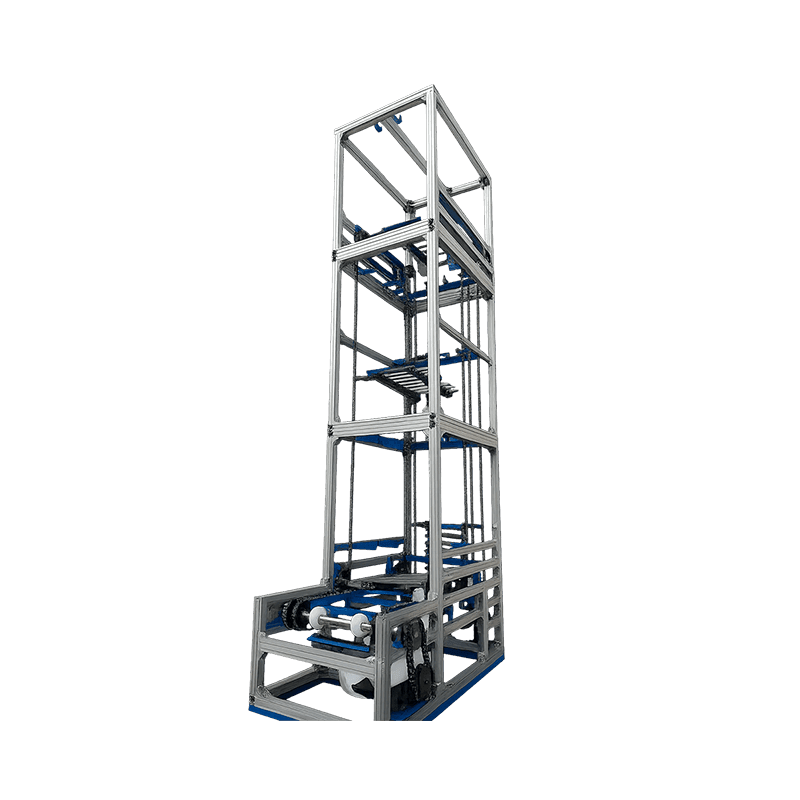






The 50 kg/m C-type Vertical Conveyor mainly solves vertical transfer needs between different floors in warehouses and factories. It is suitable for metal drums, plastic drums, rolls, and cartons, and can also be used for bagged goods with a single-item weight within 50 kg and dimensions that fall within the effective width range of the equipment. Before procurement, first check three things: first, whether the actual lifting height on site falls within the 4-20 meter range; second, whether the single-item weight, bottom dimensions, and loading posture are suitable for the C-type infeed and outfeed method; third, whether the heights of the Hydraulic Conveyor, roller line, or floor platform before and after the equipment have been confirmed, otherwise the infeed/outfeed port height and transfer method need to be confirmed by engineering.
Applicable sites and cargo boundaries
This model is mainly used for vertical transfer between floors, suitable for upward or downward conveying between warehouses, workshops, mezzanines, and floor storage locations. The C-type structure is typically used where the infeed and outfeed directions need to be arranged in a C shape. The site focus is not the name itself, but whether the direction, platform position, and operator position are appropriate when goods enter and leave the lifting section.
First judge the cargo boundaries according to the following conditions:
- Single-item weight does not exceed 50 kg.
- Common cargo forms include metal drums, plastic drums, rolls, and cartons, and you can also first check the bottom support and shape stability of bagged goods.
- The bottom dimensions of the cargo must fall within the usable specification range of the equipment; common effective widths correspond to cargo sizes of 0.6 × 0.8 m, 0.8 × 0.8 m, and 0.8 × 1.2 m.
- Before goods enter the Vertical Conveyor, they should remain relatively stable in shape, avoiding looseness, protrusions, easy slipping, or obvious shifts in center of gravity.
- If the goods are palletized cargo, overweight cargo, or cargo with a high center of gravity that exceeds the above dimensions, the load-bearing and conveying method must be reconfirmed.
If the goods on site frequently mix multiple types of packaging, first check against the maximum overall dimensions and the least stable type of cargo, rather than judging only by the most common carton type.
Cómo interpretar los parámetros clave
The parameters that have the greatest impact on procurement and layout are concentrated in lifting height, load capacity, cargo size range, drive method, and motor power. There is no need to expand all the details at once; first check the key parameters.
| Parámetro | Repercusión en la selección del modelo | Cómo confirmarlo in situ |
|---|---|---|
| Lifting height 4-20 m | Directly determines the model length and floor coverage range | Measure the actual height from the lower feed point to the upper discharge point |
| Load capacity 50 kg/m | Determines the conveying load boundary per unit length | Check single-item weight, feeding interval, and the number of goods on the machine at the same time |
| Single item ≤ 50 kg | Determine whether the goods can be used directly with this model | Base it on the heaviest single item, not on the average weight |
| Goods dimensions: 0.6 × 0.8 m, 0.8 × 0.8 m, 0.8 × 1.2 m | Affects side guards, guidance, and loading/unloading stability | Measure the length and width of the bottom surface of the goods, including the maximum size after the outer packaging bulges |
| The drive method is chain transmission | This affects operation, maintenance, and installation conditions | Confirm the on-site maintenance aisle, lubrication, and tension inspection space |
| Lifting motor power: 750-3700W | This is related to the lifting height and also affects the power supply configuration | Check the on-site power capacity and wiring location according to the final model |
Within the same model group, the motor power is 750W for 4-6 m models, 1500W for 7-12 m models, 2200W for 13-17 m models, and 3700W for 18-20 m models. Motor power changes with height, so on-site power supply, distribution box location, and start/stop control method must be confirmed together with the final model.
How to connect the front and rear sections of equipment
This type of Vertical Conveyor is usually not used alone, and the connection between the front and rear sections is more critical than the height of a single unit. If the incoming material from the lower level comes from a slope section, it can be matched with Transportador hidráulico for coordination; if both ends of the upper and lower floors require horizontal transfer, the common connecting equipment is Transportador de rodillos motorizado.
When connecting, focus on confirming the following:
- Lower-level loading height: the end height of the incoming roller line or Hydraulic Conveyor must match the feed inlet of the Vertical Conveyor.
- Upper-level discharge height: after the Vertical Conveyor discharges, whether the goods go directly to a platform, buffer position, or roller line must be determined in advance.
- Goods orientation: the orientation of cartons, drums, and roll goods before entering the Vertical Conveyor must be consistent to avoid being unable to transfer directly to the next section at the upper level.
- Cycle relationship: if the front-end loading is too dense, the lifting section and upper-level receiving area can easily become congested; if the upper level requires manual receiving, space for parking and turning around must also be reserved.
- Protection position: space near the inlet and outlet must be reserved for personnel to observe, clean, and handle shutdowns; do not place corners, door openings, and columns too close to the equipment.
If the site needs floor-level conveying to be connected to horizontal transfer, you can check similar connecting equipment, such as Transportador de rodillos accionado por cadena o O-type belt Powered Roller Conveyor.
See the related site case: /zh-CN/cases/9491
How to choose within the same series
Within the same category, if you first look at the structure and load-bearing limits, the most common comparison is between the C-type and Z-type, and between the 50 kg/m and 100 kg/m sets of conditions.
- The 50 kg/m C-type Vertical Conveyor on this page is used for floor-level conveying where a single item does not exceed 50 kg and the inlet/outlet direction is suitable for a C-type layout.
- Transportador vertical tipo C de 50 kg/m: when the on-site inlet/outlet direction is more suitable for a Z-type layout, confirm it first according to the inlet/outlet route.
- Transportador vertical tipo C de 100 kg/m: when the single-item weight, load per unit length, or combined goods clearly exceeds the 50 kg/m limit, a higher load-bearing grade should be considered.
- Transportador vertical tipo Z de 100 kg/m: when both higher load capacity and a different inlet/outlet direction are involved, check this model type again.
Within this model group, the difference between 4 m and 20 m is mainly the lifting height and matching motor power; it does not mean the acceptable goods types are automatically expanded. If the goods exceed 50 kg per item, or if the site wants to switch to larger-sized goods, engineering confirmation is required, and a longer model should not be used as a direct substitute.
On-site Layout and Maintenance
First check the floor opening, platform edge, forklift aisle, and personnel traffic routes for the installation location. The Vertical Conveyor itself is fixed equipment, so after vertical layout between floors, space should be reserved near the inlet and outlet for receiving, turning, maintenance, and shutdown handling.
When planning the layout, usually confirm:
- Whether there are any interferences from door openings, columns, fire protection equipment, or piping on the lower level.
- Whether the platform edge on the upper level allows equipment discharge and connection to the roller line.
- Whether the floor load capacity and fixed foundation meet the installation requirements.
- Whether the area around the equipment is convenient for observing the chain drive section, cleaning debris, and carrying out daily inspections.
- When loading or receiving materials manually, whether the standing position avoids the pinch area directly in front of the inlet and outlet.
Daily maintenance should focus on chain drive inspection, fastener inspection, abnormal operating noise, the guide sections at the inlet and outlet, and whether materials are jammed. Cartons that absorb moisture and deform, bagged goods that bulge, and drums with protruding outer edges will all affect passage during lifting. The warehouse should sort out abnormal goods in advance.
Common Questions
1. Is it suitable for mixed conveying of cartons and rolls?
It is suitable provided that both types of goods weigh no more than 50 kg per piece and their dimensions fall within the effective width of the equipment. When used on a mixed line, the placement direction and spacing before entering the equipment must be standardized.
2. Which floor dimensions need to be confirmed?
First confirm the lower-level feed height, the upper-level discharge height, the floor opening position, the distance from the platform edge to the equipment center, and the height of the roller lines on the front and rear sections.
3. Can it be directly connected to Hydraulic Conveyor or a roller line?
It can be used for connection, but the inlet and outlet heights, product direction, and transfer space must be confirmed on site; if there is a large difference in the cycle time of the front and rear equipment, it is also necessary to confirm whether a buffer section is required.
4. How should drums or boxes over 50 kg be handled?
The load capacity and conveying method need to be reconfirmed, and if necessary, consider Transportador vertical tipo C de 100 kg/m or another solution; it cannot be used directly as this model.
Pre-Purchase Confirmation
To avoid having to change the layout after the equipment arrives, it is recommended to confirm the following information once before purchasing:
- Lifting height: the actual dimension from the lower-level feed point to the upper-level discharge point.
- Goods list: maximum weight, maximum overall dimensions, base dimensions of the goods, and whether the packaging is mixed.
- Goods flow direction: which side to feed in from and which side to discharge from, and whether direct connection with a platform or roller line is required.
- Front and rear equipment: whether to connect Hydraulic Conveyor and Powered Roller Conveyor, and what the respective connection heights are.
- Installation conditions: floor opening, foundation position, column door opening, power supply location, and maintenance passage.
- Usage method: manual loading, manual receiving, or automatic feeding and discharge by the front and rear equipment.
If the site has already determined that vertical conveying between floors is needed, but the cargo weight, size, or inlet/outlet direction has not yet been finalized, first confirm the maximum cargo form and the elevation at both ends, and then select the specific model within 4-20 meters.